1. Parse and de-identify
Each CV, in any format, becomes a structured profile of roles, dates, skills, qualifications and achievements. Name, photo, age, address and other protected attributes are stripped before matching.
Parse every CV into a structured profile, match it to the role's written requirements with quotes as evidence, and hand recruiters a consistent summary for every candidate, from the first to the last.
A popular role attracts several hundred applications within days. The recruiter reads the first batch carefully, skims the next and may never open the rest. Two recruiters screening the same role apply different standards. Good candidates with unusual CV formats are missed, and the hiring manager waits weeks for a shortlist.
Keyword filters in the applicant tracking system make this worse, rewarding candidates who repeat the job advert. The fix is to extract what each candidate has actually done, compare it with what the role actually needs, and show the recruiter the evidence, so the human decision is faster and fairer.
Each CV, in any format, becomes a structured profile of roles, dates, skills, qualifications and achievements. Name, photo, age, address and other protected attributes are stripped before matching.
Every must-have and nice-to-have from the role template is checked against the profile. The output is "met, partially met, not found", with the CV sentence that supports each verdict, never a single opaque score.
Recruiters see a consistent summary per candidate, sortable by any requirement, and choose who advances. The system drafts interview questions and proposes slots, and writes the recruiter's decision back to the ATS.
Consistent, searchable profiles from any CV layout, built on the same extraction engine as our document processing pipeline, stored in your ATS.
Hiring managers describe roles as explicit requirements rather than prose adverts. The template drives matching, so the standard is the same for every applicant and every recruiter.
Outcome comparisons across groups on historical data, repeated on every change, with reports written for your AI governance file and EU AI Act obligations.
Tailored question sets per candidate based on gaps in the evidence, and proposed interview slots from the panel's calendars, confirmed by the recruiter.
Time to shortlist, recruiter agreement with AI summaries, requirement coverage per role and outcome distributions over time, so drift is visible before it becomes a complaint.
Recruitment is listed as a high-risk use in the EU AI Act, and we design as if that applies to you wherever you hire. Accuracy thresholds: parsing and requirement matching are measured against a recruiter-labelled sample before launch; uncertain matches are shown as "not found", never guessed. Human-in-the-loop: no candidate is rejected or advanced by the system; a named recruiter owns every decision. Audit trail: profile, requirement template version, evidence, summary, recruiter decision and bias test results are retained per role. PII handling: protected attributes are removed before matching, candidate data follows your retention policy, and processing stays in your region, per EU AI Act readiness. The full control set is described under AI security and governance.
Requirement templates for the first role families, a labelled sample of past applications, and a written impact assessment for the governance file.
CV parsing, de-identification, matching and summaries, with the bias test suite run on historical data and the results reviewed with HR and legal.
Recruiters screen live roles as usual and compare with the AI summaries afterwards. Disagreements are analysed and templates adjusted.
Summaries become the primary screening view, the dashboard goes live, and the talent team is trained to maintain templates and read the fairness reports.
A growing services company hires steadily for a handful of role families, including customer support, field engineers and account managers, and receives hundreds of applications per opening. A small talent team screens them by hand and hiring managers complain about slow shortlists. The first release covers the two highest-volume role families. During the parallel pilot, recruiters find that the AI summaries surface candidates with relevant experience described in unfamiliar terms, who keyword filters had been hiding. The bias tests on historical data are reviewed with legal before go-live and repeated monthly afterwards. Recruiters keep the decision, reach a shortlist in days rather than weeks and spend the recovered time on candidate conversations. Onboarding the hires is then handled by the AI onboarding and training assistant.
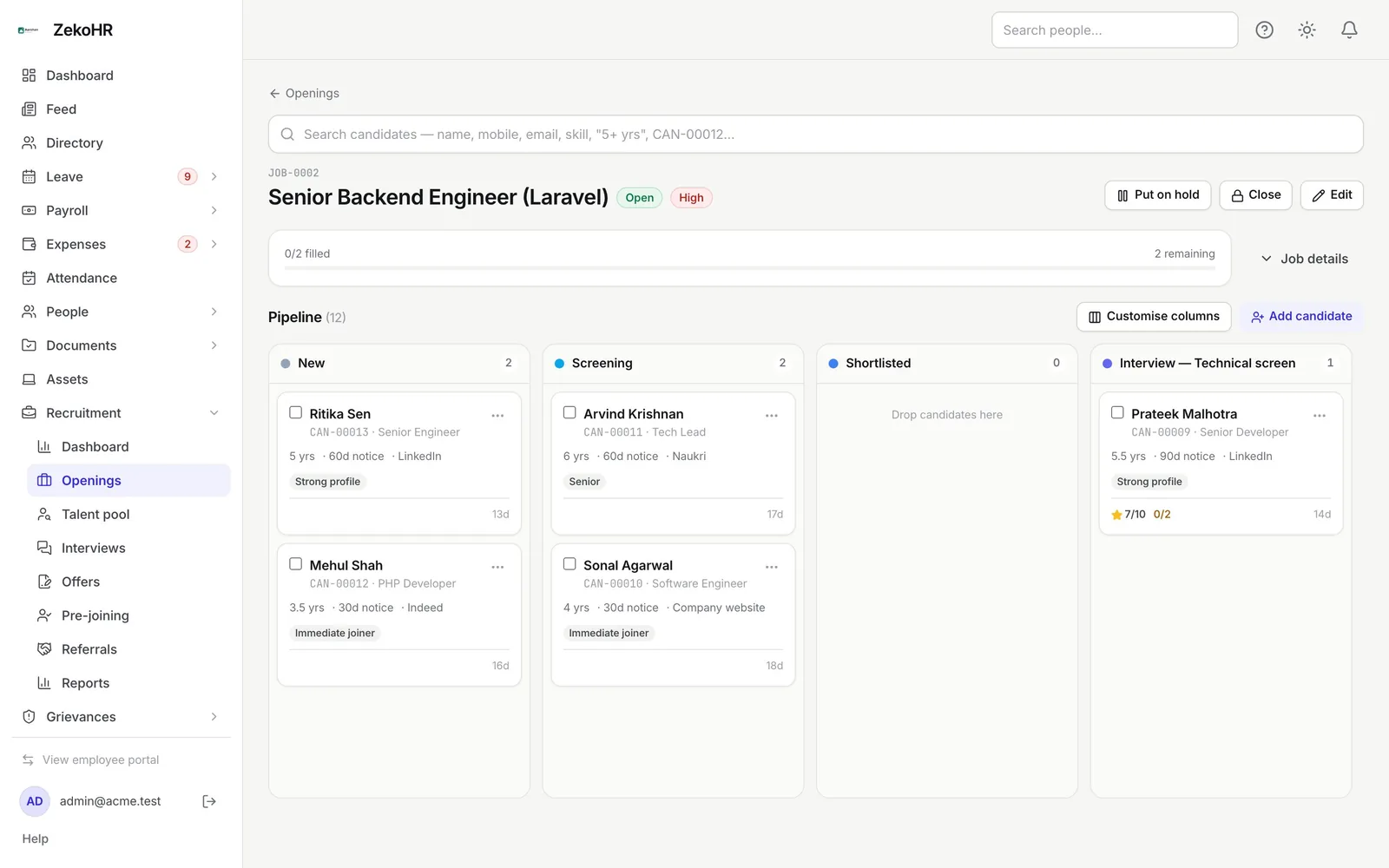
We run a recruitment module inside our own HR platform; read the ZekoHR case study for the wider context.
No. It never auto-rejects and never auto-advances. It produces an evidence-based match summary against the role's stated requirements, and a recruiter decides every shortlist. This is both our design principle and a practical requirement under the EU AI Act, which classifies recruitment systems as high-risk. See EU AI Act readiness.
Before launch we run the matching step over a historical sample with names, addresses, dates of birth and photos removed, compare outcomes across groups, and document the results. Protected characteristics are excluded from the profile the model sees. The tests are repeated on every model or prompt change, and the reports form part of your governance file under AI governance.
Any with an API. We read applications from the ATS and write back structured profiles, match summaries and recruiter decisions, so the ATS remains the single source of truth. Our own HR platform, ZekoHR, has a recruitment module we have integrated in this way.
Candidates are told how their application is processed, CV data is retained only for the period your policy allows, and personal data is masked in model logs. Processing takes place in your chosen region. Details are in AI data privacy.
Ten to fourteen weeks: two to define requirement templates and label past hires, four to six to build parsing, matching and bias tests, and four for a pilot on live roles with recruiters comparing the AI summaries with their own screening.
Tell us what you are trying to do, which systems are involved and what is in the way. We reply within one business day with an opinion and a suggested next step.